
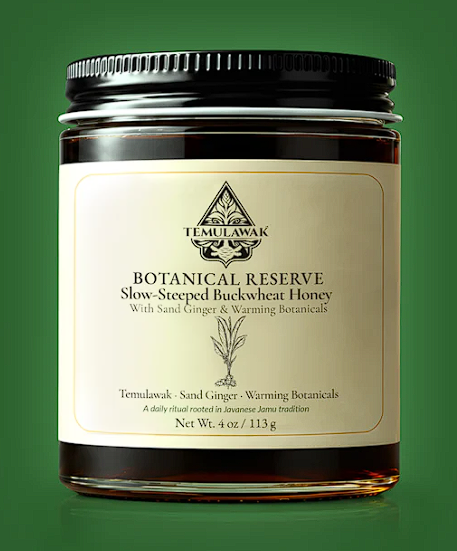

Single-estate · 1,500 acres · Columbia River Gorge

Fermented buckwheat honey,
a Jamu tradition reimagined.

Slow-fermented in small batches with Javanese turmeric, red ginger, clove, star anise, and Ceylon cinnamon. Made from honey we harvest on the land we farm.

Worm castings only·Never pasteurized·Our hives·Our hands
Temulawak slowfermented buckwheat honey jar with fresh Javanese turmeric, clove, and Ceylon cinnamon on cream linen.
The Honey

A dark, malty honey with the warm spice of mulled wine.

Buckwheat sits at the bold end of the honey spectrum — closer to molasses than clover. We start there because that's the varietal with the highest natural polyphenol and mineral load. Then we slow-ferment it with Javanese Jamu botanicals, building a honey with body, warmth, and a long finish.

01 · Tasting notes
  • Dark, malty base
  • Earthy turmeric, peppery ginger
  • Sweet clove, anise warmth
  • Ceylon cinnamon finish
  • Long, complex, tannin-friendly
02 · How to use it
  • A spoon in tea, coffee, or warm water
  • Drizzled on aged cheese or yogurt
  • Brushed on roasted root vegetables or duck
  • Straight off the spoon — its original use
03 · Format & price
  • 4 oz amber glass jar — $22
  • 8 oz amber glass jar — $34
  • 2 oz mini — gift-set and tasting size
  • Subscribe & save 15% — every 60 or 90 days
  • Free shipping over $60
Subscribe and save 15% · Ships every 30, 60, or 90 days · Skip or cancel anytime.
Start a subscription
The Full Chain

From our soil. Our bees. Our hands.

Almost no premium honey brand can describe its full chain. We can — because we own every step. One terroir, one set of hands, the same logic that produces a great single-vineyard wine.

Hands harvesting fresh turmeric roots from rich soil in a natural farm, showcasing the raw ingredients behind premium fermented buckwheat honey products.
Harvesting Temulawak rhizome in Central Java. The same hands-on logic guides the buckwheat operation in the Columbia River Gorge.
01
Soil

1,500 acres in the Columbia Gorge, fed only with worm castings and worm tea. No synthetic fertilizers, no herbicides, no fungicides. The whole farm is one regenerative system.

02
Plant

A single varietal: buckwheat. Grown on biologically active soil, the plant expresses its full polyphenol load — the rutin, chlorogenic acid, and quercetin that make this honey nutritionally dense.

03
Hive

Our own bees foraging our own buckwheat. A contained, controlled forage radius — a level of provenance no honey sourced from third-party beekeepers can claim.

04
Jar

Slow-fermented in small batches with traditional Jamu botanicals: Javanese turmeric, red ginger, clove, star anise, Ceylon cinnamon. Never pasteurized. Never extended.

The Science, Briefly

At the top of the antioxidant spectrum.

In peer-reviewed comparisons, buckwheat honey contains higher total phenolics, higher cellular antioxidant activity, and higher concentrations of iron, manganese, and zinc than manuka honey — the most famous functional honey on the market.

What that means in plain language: the polyphenol load is the highest of any commercial honey varietal, and our regenerative soil program lets the buckwheat plant express that profile fully.

Then we add a layer no manuka producer can claim: slow fermentation with traditional Jamu botanicals — turmeric, red ginger, clove, star anise, and cinnamon — transforming the honey into something neither a beekeeper nor an herbalist could produce alone.

We don't make medical claims. We do make a deeply considered functional honey, formulated by a Registered Holistic Nutritionist, Registered Dietitian, Master Herbalist, and Master Fermenter — the same person who farms the land.

Deng et al., Food Chemistry, 2018
Majewska et al., Foods, 2024
Wilczyńska & Żak, Int. J. Mol. Sci., 2024
Buckwheat vs. Manuka
Attribute
Buckwheat
Manuka
Total phenolics
Higher
Lower
Cellular antioxidant activity
Higher
Lower
Iron, manganese, zinc
Higher
Lower
Non-peroxide antibacterial (MGO)
Higher
Lower
Botanical complexity
Higher
Lower
Source: Deng et al., 2018 head-to-head comparison.
A 1,200-year tradition

Jamu, learned where it's lived.

Temulawak is the Javanese name for a golden, bitter-warming turmeric root used at the center of Jamu — Indonesia's twelve-hundred-year-old tradition of botanical wellness tonics, prepared daily across Java by women who carry the recipes through families.

I didn't learn Jamu from a book. I lived in Indonesia for two years studying Temulawak and the broader Jamu tradition — sitting with women who'd been making these formulations every morning for forty years, learning which roots get dug at which time of year, how the fermentation behaves in tropical heat, and which combinations the elders trusted most.

What I brought home is built on that grounding. Javanese turmeric anchors a blend of red ginger, clove, star anise, and Ceylon cinnamon — botanicals traditionally used for warmth, digestion, and resilience. Slow fermentation extends and concentrates them into a honey you can keep on a shelf and use daily.

The formulation isn't decorative. It carries a tradition I was taught directly, by the people who keep it alive.

— john walker, founder

Fresh turmeric roots being sliced by hand on a woven tray, highlighting the natural ingredients and traditional preparation behind premium fermented buckwheat honey products.
Slicing Temulawak in Central Java, the way it has been done for centuries.
Why this honey exists

It started with a promise to my mother.

In 2010, both of my parents were diagnosed with cancer — my father with late-stage pancreatic cancer, my mother with breast cancer. I was already a Registered Holistic Nutritionist and Registered Dietitian, and I wanted to help them in the only way I knew how: through food.

The hardest thing to watch wasn't the diagnosis. It was the appetite loss. They couldn't eat. They couldn't keep food down. They were losing strength in a way no amount of nutrition counseling could fix from the outside.

In my research I kept landing on the same place — Indonesia, home to more than 21,000 documented medicinal plants and an unbroken twelve-hundred-year tradition of botanical formulation called Jamu. So I went. I ended up staying two years, studying Temulawak — Javanese turmeric — and the wider Jamu tradition with the women who carry it.

My mother, Edna, was the first person I brought a formulation home for. For the first time in months, she ate. Her strength came back enough that we got to spend real time together again. Before she passed, she asked one thing of me:

“Share this root with others — especially the people like me, going through treatment, who feel like giving up on food.”

— Edna

Temulawak LLC exists to keep that promise.

This honey is the next chapter of it. I came back to the United States, found 1,500 acres of land in the Columbia River Gorge, planted it to buckwheat, brought in my own bees, and built a closed-loop system fed only with worm castings and worm tea. Buckwheat honey carries the highest natural polyphenol load of any commercial varietal — the right base for a Jamu-style fermentation. The Jamu botanicals carry the tradition my mother helped me find.

I don't have a marketing team, a co-packer, or a contract beekeeper. The land, the bees, the formulation, the fermentation — all of it is mine. That's the only way I know how to do this honestly.
If you ever want to see the operation, you're welcome on the farm.

RHN · RD · Master Herbalist · Master Fermenter · Regenerative Farmer
Freshly harvested turmeric roots being washed in a river, reflecting the natural sourcing and traditional craftsmanship behind premium fermented buckwheat honey products.
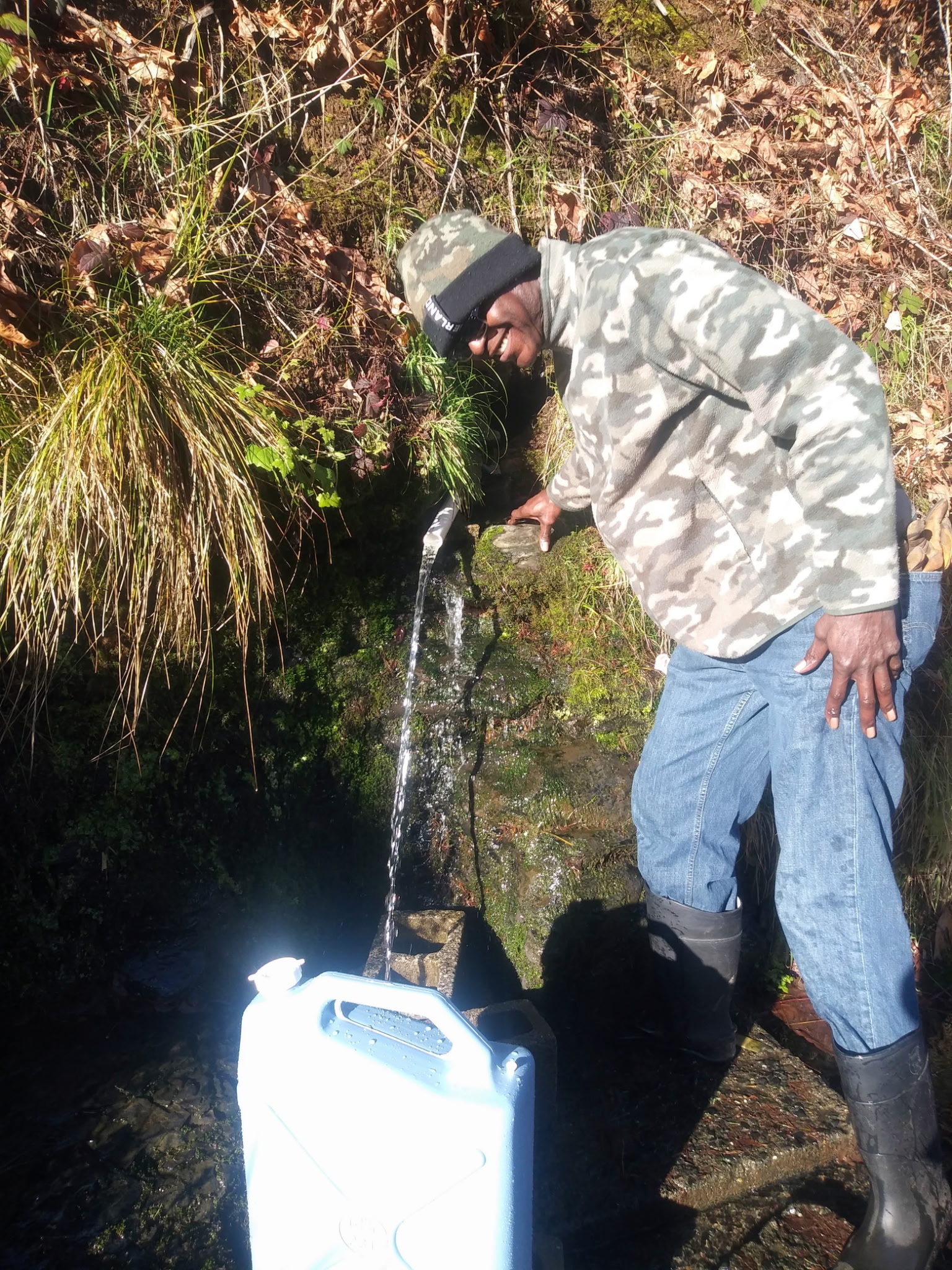
Bottling spring water for worm tea. The water emerges from the property — the same source that’s been feeding this land for generations.
Registered Holistic Nutritionist
Registered Dietitian
Master Herbalist
Master Fermenter
Regenerative Farmer
Two years in residence · Java

Honey, the way it's supposed to be made.

Single-estate. Regeneratively farmed. Slow-fermented in small batches. Shipped directly from our farm in the Columbia River Gorge.

Buy an 8 oz jar — $34
Free shipping over $60 · Ships within 3 business days · Money-back guarantee on first order
Questions

A few things, answered.

What does it taste like?
+
Is it raw?
+
How is it different from manuka?
+
What does “single-estate” actually mean?
+
Are you certified organic?
+
How long does a jar last?
+
Do you ship outside the U.S.?
+
Wholesale?
+
Field Notes

A quarterly letter on fermentation, regenerative farming, and the botanicals that make their way into the jar.